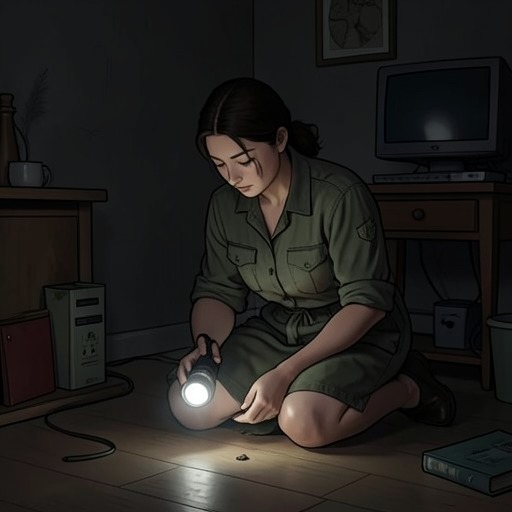
Blake and Glenys Probert
Panic RoomBlake and Glenys Probert’s relationship turns the routine of tending Wortalleth West into a quiet form of mutual trust. Glenys is employed to care for the garden, but her attention extends beyond the plants: she notices Blake’s vulnerability, offers shelter without demanding an explanation, and eventually urges her to leave a place that has become dangerous. Her care is practical rather than demonstrative, and Blake understands its value precisely because Glenys does not press her to speak.
Work and Regard
Glenys works hard at Wortalleth West despite the absence of anyone monitoring her, least of all Jack Harkness. Her pay arrives on the first of each month, with Blake paid through Glenys. Blake notes the irony that Harkness apparently no longer owns the property and does not come down to enjoy its garden, while the work and its regular payment continue. The arrangement makes Glenys and Blake part of the house’s everyday maintenance even as its ownership and future seem uncertain.
Blake’s respect for Glenys is personal as well as professional. She describes her as sinewy and weather-tanned, with self-cut hair, practical clothes, and a dazzling smile that appears rarely. Glamour is not what makes Glenys matter to her; Blake values her as genuine. That judgment helps explain why Blake goes to her in the garden as soon as she arrives to tell her the news affecting Blake’s own future. She wants Glenys to hear it directly, rather than discover it by some other route.
Shelter Without Pressure
Glenys receives the news with philosophical directness. She expresses sympathy for Blake and asks where she will go, then points out that selling the property will take months. If Harkness keeps paying, she will continue tending the plants, giving Blake time to find somewhere else to live. The response is neither a promise that everything will be settled nor an attempt to minimize the uncertainty; it identifies the time and practical support still available.
Glenys also recognizes that Blake is running away from something. She has not said so before, because pressing the point is not her way. Instead, while digging out a weed, she offers to put Blake up for a while if necessary. The casual delivery makes the offer characteristic of Glenys, but not insincere. She lives in St Keverne, and Blake has never visited her home; Blake suspects it is tiny and knows Glenys is accustomed to solitude. Even so, she believes Glenys would make room and make the arrangement work. Blake thanks her with eye contact meant to show that the offer is understood and appreciated, while still saying she will sort something out herself.
Warning and Changed Circumstances
The trust between them becomes more consequential after Don Challenor discovers the panic room and Blake hears what Dale has said about it. On the drive away from the crash scene towards Helston, Blake tells Glenys what she knows. She recognizes that keeping Glenys uninformed now seems foolish: the accident has added to her doubts, and the abrupt change from a simple life to a confusing, threatening situation leaves her feeling trapped in a quagmire. Glenys listens for a long time without interrupting. She lights another roll-up and watches the road; Blake does not hurry her, knowing that Glenys cannot be hurried into speaking.
Near the Culdrose roundabout, Glenys gives her answer plainly: Blake should clear out of Wortalleth West. When Blake asks whether matters are really that bad, Glenys argues that there is no reason to wait and find out. She believes Harkness is finished and says she reads the newspapers Blake throws out; in her view, the wolves are circling. The warning is grounded in her own observation of the wider danger around Harkness, but it also carries the force of someone who has already noticed Blake trying to escape an undisclosed problem. Glenys does not demand that Blake explain herself before she can advise her.
Continuing Care
Glenys’s support does not end with the warning. After stopping in a bay, she tells Blake she will come the next day. Blake points out that Saturday is not one of Glenys’s working days, but Glenys says she will come anyway, simply to check how Blake is. The promise marks the difference between paid garden work and personal concern: even when the ordinary schedule does not require her presence, she chooses to return. Across these encounters, Glenys offers Blake time, possible shelter, candid counsel, and a follow-up visit without turning any of them into an obligation. Blake’s gratitude and willingness to confide in her show a bond sustained less by declarations than by the reliability of such gestures.